A furniture factory should consider woodworking automation when manual handling, repetitive processes, inconsistent production flow, capacity limitations, or recurring bottlenecks begin restricting operations. Automation makes the most sense when it solves a clearly identified production problem rather than simply adding more technology to the factory.
The right time to upgrade depends on product type, production volume, labor requirements, component variety, existing machinery, and how effectively different stages of manufacturing work together.
What Does Woodworking Automation Actually Mean?
Woodworking automation means using machinery, controls, software, and material-handling systems to perform or coordinate production tasks with less repetitive manual intervention.
It does not necessarily mean creating a completely unmanned factory.
Automation can be introduced at individual stages. A manufacturer might automate panel loading, CNC nesting, drilling, labeling, conveying, sorting, or another repetitive operation while retaining manual processes elsewhere.
A more integrated production line may connect several of these stages so that materials and production information move through the factory in a coordinated way.
Look for Production Bottlenecks First
A bottleneck occurs when one stage cannot keep pace with the rest of the production process.
For example, a factory may have sufficient CNC cutting capacity but still rely heavily on manual loading and unloading. The machining center may be capable of processing more components, yet operators spend significant time moving sheets and finished parts.
Another factory may cut panels efficiently but develop queues before drilling or edge banding.
These situations are important because they show where automation could provide practical value.
Rather than asking, “Which process can we automate?” manufacturers can ask, “Which process is limiting our production flow?”
That question usually provides a better starting point.
When Woodworking Automation Can Improve Throughput
Higher demand is a common reason to investigate automation, but simply buying a faster machine does not guarantee higher factory output.
Throughput depends on the complete production sequence.
If cutting becomes faster while drilling, edge banding, sanding, or material handling remains constrained, work-in-progress can accumulate between stages.
Factories considering woodworking automation should therefore map the movement of material from raw board or timber through machining and toward assembly.
This helps identify whether the real constraint is machining speed, loading, unloading, component identification, transportation between machines, or another process.
Repetitive Material Handling Is a Strong Automation Candidate
Furniture manufacturing can involve repeated movement of sheets, panels, components, and finished parts.
When workers spend substantial effort repeatedly loading, unloading, transferring, or sorting predictable components, automated material handling may be worth evaluating.
Depending on the production environment, this can include:
- Automatic loading and unloading
- Conveyors
- Panel feeding systems
- Component return systems
- Automated labeling
- Sorting or transfer equipment
The objective is not simply to remove manual work. It is to create a smoother flow between manufacturing stages where repetitive handling is slowing production or creating unnecessary interruptions.
Automation Can Support Repeatable Processing
Furniture components often need consistent cutting, drilling, routing, or positioning across repeated production runs.
CNC systems already automate many machining movements from programmed instructions. Additional automation can extend this controlled process to tool changes, workpiece positioning, material feeding, labeling, or component transfer.
This can be particularly useful for panel furniture, cabinets, wardrobes, doors, and other products where many components follow defined machining data.
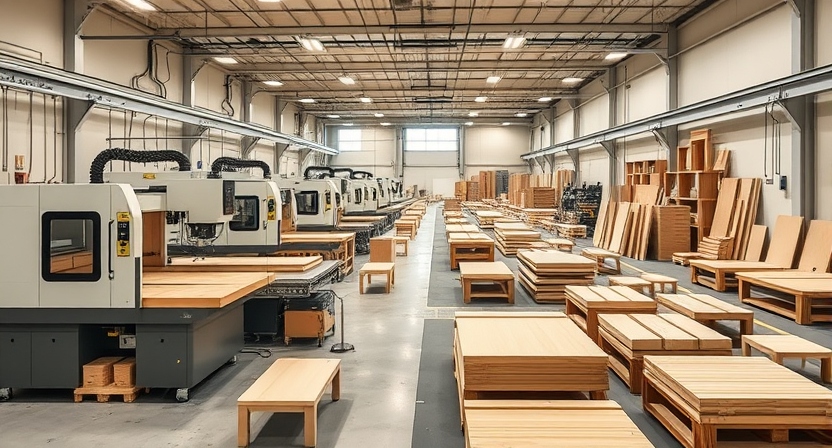
Factories evaluating automated furniture production solutions should consider how CNC machining, material handling, panel processing, drilling, and other operations could fit together around their actual product flow rather than viewing each automated machine separately.
SAMACH is one example of a woodworking machinery supplier whose broader equipment context can be considered when manufacturers are researching how different production stages may be organized.
When Labor Constraints Justify an Upgrade
Automation can also become relevant when repetitive production tasks require significant operator attention.
However, labor reduction should not be evaluated only as a simple headcount calculation.
Manufacturers should examine what workers actually do during each production stage. If skilled operators spend large amounts of time loading panels, waiting for machine cycles, transferring components, or performing repetitive positioning, automation may allow their time to be used elsewhere.
At the same time, automated machinery introduces its own requirements. Factories still need people who can operate, program, monitor, maintain, troubleshoot, and coordinate equipment.
Therefore, the goal is often to change how labor is used rather than assume that automation eliminates the need for skilled staff.
Product Variety Changes the Automation Decision
High production volume can make repetitive automation easier to justify, but volume is not the only consideration.
A factory producing the same component repeatedly has different requirements from a custom furniture manufacturer handling frequent design changes and small batches.
Flexible CNC technology can support product variation because machining instructions can change digitally. However, the wider automated system must also handle those changes efficiently.
If every new product requires lengthy mechanical setup, a highly automated line may not provide the expected flexibility.
Factories should therefore evaluate batch size, changeover requirements, product mix, and component variation before deciding how far to automate.
Should a Factory Automate One Machine or the Whole Line?
In many cases, targeted automation is a practical starting point.
A manufacturer might first automate the process creating the most significant bottleneck. Once that stage is improved, the factory can observe how the change affects downstream production.
Sometimes solving one bottleneck reveals another.
For example, automated panel processing may increase component output enough that drilling becomes the next constraint. Improving drilling may then place more pressure on edge banding or assembly.
This is why automation planning should be iterative and based on the complete production flow.
Consider Integration With Existing Equipment
New automated equipment should not be evaluated in isolation from machines already operating in the factory.
Manufacturers need to consider material dimensions, production sequence, floor layout, feeding and unloading requirements, software compatibility where relevant, dust extraction, operator access, maintenance space, and downstream capacity.
A machine can be technically advanced yet still create an inefficient workflow if components must repeatedly travel backward across the factory or wait for another process.
Physical layout is therefore an important part of automation planning.
Evaluate the Upgrade Beyond Machine Price
The purchase price is only one part of an automation decision.
Factories should also consider installation, tooling, training, maintenance, software where applicable, material-handling changes, production disruption during implementation, and the resources required to operate the system.
Potential benefits should be tied to identifiable problems such as a capacity constraint, repetitive handling requirement, excessive work-in-progress, difficult production coordination, or a need for more repeatable processing.
This creates a more useful basis for evaluating return on investment than assuming automation is automatically beneficial because it is newer technology.
When Is a Factory Ready for Automated Woodworking Equipment?
A factory is more likely to be ready when it can clearly define what automation needs to improve.
That may mean increasing throughput at a constrained process, reducing repetitive material movement, coordinating CNC operations more effectively, improving repeatability, or supporting growing production demand.
Before upgrading, manufacturers should map the current workflow, identify bottlenecks, document component movement, examine labor-intensive tasks, and determine how new equipment will interact with existing processes.
Automation works best as a response to a defined manufacturing requirement. When a furniture factory understands its constraints first, it can choose technology that supports the production system instead of adding complexity without solving the underlying workflow problem.